
Federal CDL Rule: Supply Chain Risk and Workforce Reshaping
New federal CDL rules restrict non-domiciled drivers, potentially removing 200,000 truckers & straining US supply chains.
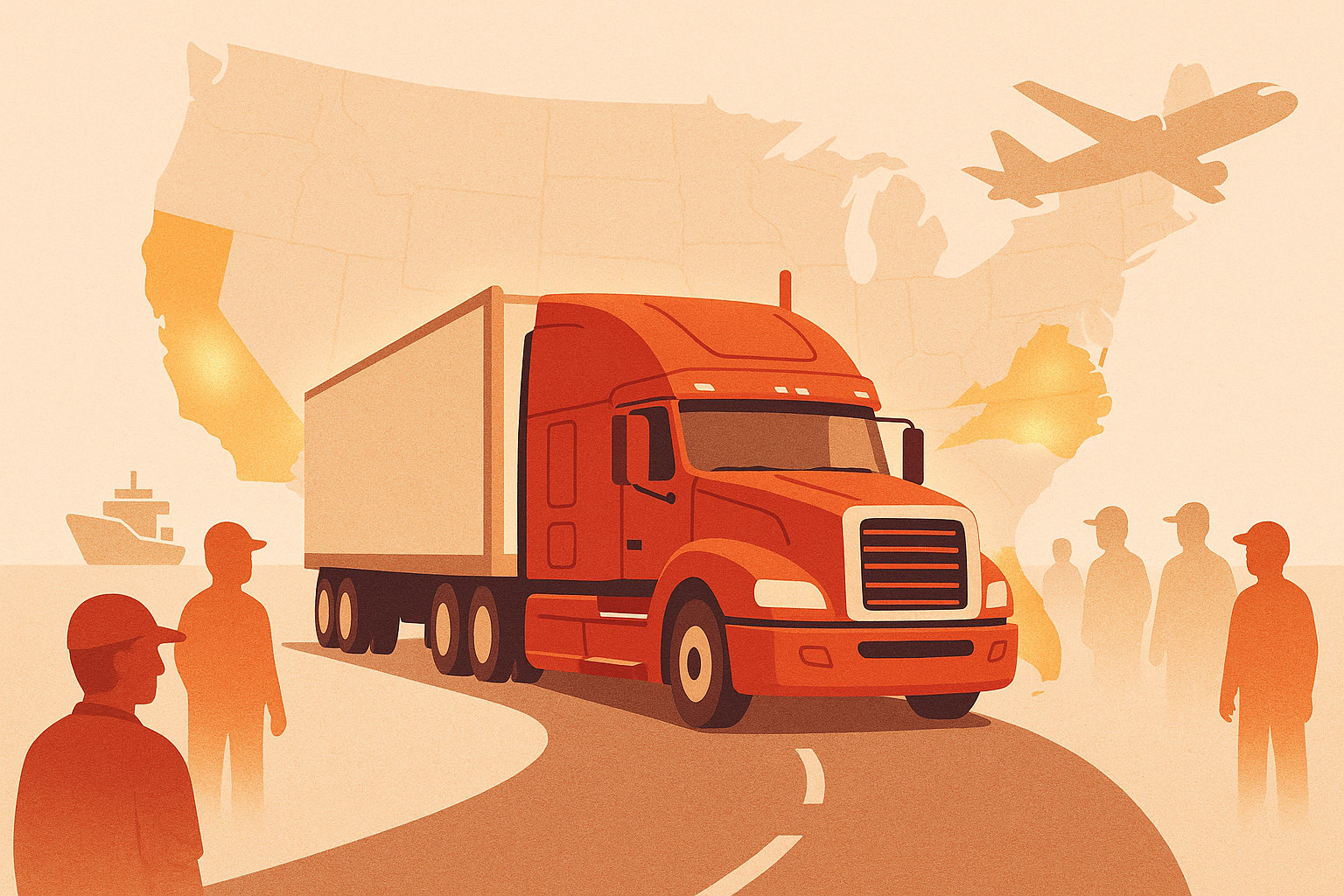
A new federal rule, starting March 16, 2026, will allow only certain visa holders - H-2A, H-2B, and E-2 - to get or renew commercial truck driving licenses in the U.S. This change could force a significant number of immigrant truck drivers off the roads over the next five years, making the truck driver shortage worse. Because trucks carry most of America's goods, losing many drivers could delay deliveries, raise shipping costs, and hurt the supply chain, especially in states like Texas, California, and Florida. Small trucking businesses may struggle the most, while legal fights and industry pushback are already starting. The effects will be felt slowly as current licenses expire one by one over the coming years.
What is the new federal CDL rule and how will it affect the trucking workforce?
The new FMCSA rule, effective March 16, 2026, restricts non-domiciled commercial driver's licenses to H-2A, H-2B, and E-2 visa holders. FMCSA estimates approximately 194,000 of roughly 200,000 non-domiciled CDL drivers will be eliminated over time as licenses expire, worsening driver shortages and threatening U.S. supply chain stability.
A sweeping federal regulatory change is reshaping America's trucking workforce, with potentially far-reaching consequences for the nation's supply chains and economy. The Federal Motor Carrier Safety Administration (FMCSA) finalized new rules on February 13, 2026, dramatically restricting who can obtain or renew non-domiciled commercial driver's licenses (CDLs). The rule uses five-year license attrition to mitigate impact, though the precise number of affected drivers remains under review.
The New Eligibility Framework
The FMCSA rule, titled "Restoring Integrity to the Issuance of Non-Domiciled Commercial Drivers Licenses," fundamentally narrows CDL eligibility for non-citizens. Previously, many states allowed individuals with various work authorization documents to obtain commercial licenses. Under the new framework, only three visa categories now qualify for non-domiciled CDLs:
- H-2A visas (temporary agricultural workers)
- H-2B visas (temporary non-agricultural workers)
- E-2 visas (treaty investors)
This restriction excludes numerous groups who previously held valid licenses, including DACA (Deferred Action for Childhood Arrivals) recipients, asylum seekers, refugees, individuals with Temporary Protected Status, humanitarian parolees, and holders of other visa categories with employment authorization documents. According to industry reports, a significant portion of current non-citizen CDL holders will be ineligible for renewal under the new restrictions.
A Gradual Workforce Reduction
The policy creates a rolling displacement rather than immediate termination. Drivers with current, valid non-domiciled CDLs and valid work authorization can continue operating commercial vehicles until their license expires. However, once expiration occurs, only those holding the three approved visa types can renew. Federal estimates suggest FMCSA estimates approximately 194,000 of roughly 200,000 non-domiciled CDLs could be affected over a five-year period as licenses reach their renewal dates on staggered schedules spanning 12-24 months.
Some states have taken even more restrictive approaches. Idaho eliminated its non-domiciled CDL program entirely, now requiring all applicants to prove both Idaho residency and U.S. citizenship - going beyond federal requirements.
Supply Chain Implications
The timing of this regulatory crackdown compounds existing workforce challenges in the trucking industry. Immigrants comprise a significant portion of truck drivers nationwide, with particularly high concentrations in long-haul freight operations. The industry, which is largely composed of small businesses operating limited fleets, already faces significant driver shortages driven by retirements, weak domestic recruitment, and stricter English proficiency requirements.
Trucks moved approximately 72% of U.S. freight by weight in 2019-2022, including consumer products, food, and construction materials, making driver shortages a direct threat to supply chain stability.
The removal of a substantial number of drivers threatens to create cascading disruptions. Industry experts warn of rising freight rates, delivery delays, disruptions to just-in-time manufacturing models, increased spoilage risk for perishable goods, construction project delays, and inflation driven by higher shipping costs passed through to consumers.
Geographic impacts will vary significantly. Texas, with a large immigrant trucking workforce and heavy reliance on border freight, port operations, and booming sectors like data centers and energy, faces particularly acute challenges. California's port-dependent economy and Florida's significant concentration of refugee and asylum-seeker drivers make these states especially vulnerable to workforce reductions.
Industry and Legal Responses
The policy change stems from deadly crashes involving non-citizen drivers in Florida and California, which led to the revocation of thousands of questionable licenses. The FMCSA argues that the vetting processes for H-2A, H-2B, and E-2 visa statuses provide background checks comparable to those for domestic CDL applicants.
However, the rule has already triggered legal challenges. Advocacy groups and affected workers contend that removing work authorization from legally present non-permanent residents undermines the workforce during a critical shortage period. One advocate characterized the policy as "a letter that removes a means of work" for individuals with legal status but without permanent residency.
Industry advisors recommend that carriers audit their rosters for affected drivers and renewal dates immediately, starting succession planning and diversified recruiting efforts now rather than waiting for CDL expirations.
Trucking companies employing non-domiciled CDL holders face mounting pressure to identify replacement drivers in an already tight labor market. The rule's impact on small carriers, which lack the resources of larger fleets, could worsen bottlenecks throughout the supply chain. Meanwhile, cross-border permits under USMCA for Mexican and Canadian drivers remain limited and tightly regulated, offering minimal offset to domestic workforce losses.
As existing licenses expire on rolling schedules in the coming years, the full economic impact of this regulatory shift will gradually materialize, testing the resilience of America's freight transportation network and the businesses that depend on it.