
California Autonomous Trucking Regulations Face Legal Challenge Amidst Safety and Labor Concerns
California's new autonomous trucking rules face a Teamsters lawsuit over safety, job loss, and improper rulemaking. Impact on 200K+ jobs.
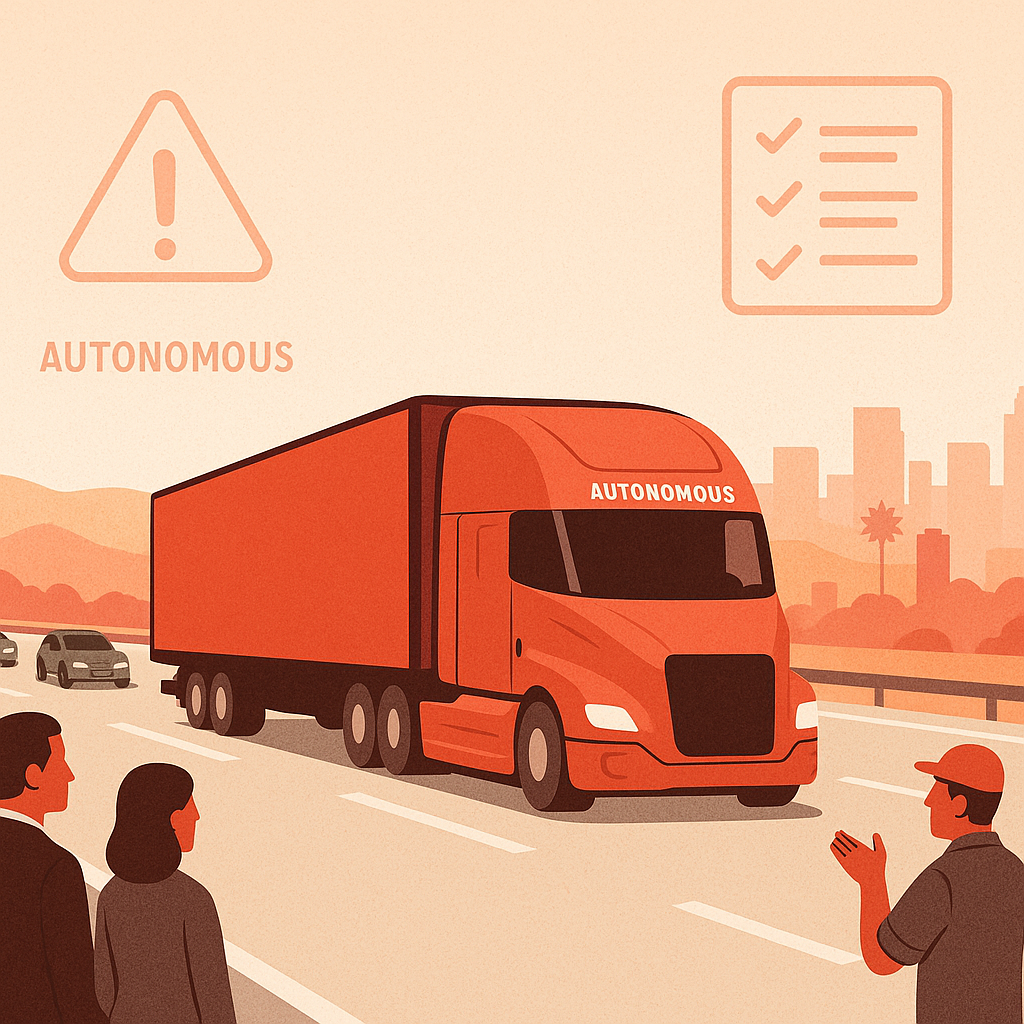
California has made new rules letting companies test and use big self-driving trucks on public roads starting in 2026. Labor unions are fighting these rules in court, saying they could put many truck drivers out of work and cause safety problems since these trucks are much heavier than regular cars. The state requires lots of test driving and special safety steps before these trucks can work without drivers. Most job losses would hit long-distance truckers, while new jobs might not pay as well. The court case will decide if the rules stay or change, and for now, these big self-driving trucks can't carry goods until all tests are passed.
What are California's new autonomous trucking regulations and why are they controversial?
California's 2026 regulations allow manufacturers to apply to test and deploy heavy-duty autonomous trucks over 10,001 pounds, subject to phased permitting and testing requirements including safety-driver and driverless testing. The rules face legal challenges from labor unions, who cite concerns over public safety and significant potential job losses in the trucking industry.
California's Department of Motor Vehicles adopted new regulations on April 28, 2026 that allow manufacturers to test and deploy heavy-duty autonomous trucks on public roads, ending a prior prohibition on autonomous vehicles over 10,001 pounds. The rules sparked immediate controversy, and on August 5, 2026, Teamsters California filed suit in Alameda County Superior Court to block the regulations.
The Core of the Legal Challenge
The lawsuit centers on three major claims. First, the union argues the DMV used an abbreviated rulemaking process intended for minor regulatory changes rather than conducting a full economic impact analysis. According to Politico's coverage, Teamsters lawyer Julie Gutman Dickinson stated the agency "irresponsibly, carelessly, and unlawfully kept the public in the dark about the true economic and human costs" of the regulations.
Second, the complaint alleges the DMV understated or ignored the labor impact of allowing driverless heavy-duty trucks. The Teamsters claim the regulations could affect a significant number of truck drivers working across California. Third, the union says the DMV failed to adequately evaluate safety risks associated with putting 80,000-pound autonomous vehicles on highways alongside passenger cars.
What the New Rules Actually Require
The California DMV's framework imposes a phased permitting system before any company can operate autonomous heavy-duty trucks commercially. Reuters reported that manufacturers must complete 500,000 miles of heavy-duty testing at each phase, for a total of 1,000,000 miles before commercial deployment authorization: first with a safety driver present, then in driverless testing mode, and only then may they apply for commercial deployment authorization.
Manufacturers must also submit a detailed safety case, and the DMV must determine that the autonomous system does not pose an "unreasonable risk of accident, death, injury, or exacerbating injury" before granting deployment permission. The regulations require AV companies to respond to first responder calls within 30 seconds and allow emergency officials to issue electronic geofencing directives to clear autonomous vehicles from active emergency zones. Heavy-duty AVs must still stop at California Highway Patrol weigh stations and comply with all applicable state and federal commercial motor vehicle requirements.
Job Displacement Estimates and Labor Market Impact
| Analysis Source | Estimated Job Impact | Key Finding |
|---|---|---|
| UC Berkeley Labor Center | Up to 294,000 long-distance drivers | Most vulnerable: 83,000 high-wage specialized jobs and 211,000 moderate-wage positions |
| Teamsters California lawsuit | Significant number of employee drivers | Does not include impact on self-employed truckers |
| Silicon Valley Leadership Group | Varies by adoption speed | Slow/medium adoption preserves jobs; fast adoption causes limited layoffs offset by turnover |
A major UC Berkeley Labor Center analysis found that autonomous trucks could replace as many as 294,000 long-distance drivers, with many replacement jobs being lower-wage local delivery roles. The report identified non-specialized long-distance driving positions as most vulnerable, including approximately 83,000 of the best-paying trucking jobs and 211,000 jobs with moderate wages but high turnover rates.
The most exposed workers are those in long-haul and repetitive-route driving, because those routes are easiest to automate. Drivers performing complex local hauling, specialized freight operations, or work requiring significant customer interaction face lower immediate risk. Any job gains are more likely to appear in local delivery, remote vehicle oversight, maintenance, and logistics support rather than replacing the same types of driving jobs at comparable wage levels.
Safety Concerns and Emergency Response
Public safety arguments form a central pillar of the opposition to heavy-duty autonomous trucks. The Teamsters' lawsuit emphasizes that self-driving trucks are "up to 16 times heavier" than passenger vehicles and may operate at highway speeds, amplifying the potential consequences of any collision or system failure.
California's response has been to impose tighter oversight rather than ban the technology. The new rules allow law enforcement to cite AV companies for moving violations committed by their vehicles. Emergency geofencing capabilities enable first responders to create "do not enter" zones that autonomous vehicles must immediately respect, addressing concerns about AVs interfering with accident scenes, fires, or other emergencies.
The Broader Context of Trucking Labor Disputes
The California lawsuit fits within a broader pattern of labor organizing around automation policy in the commercial driving sector. In Colorado, labor and trucking advocates backed legislation that would require a licensed commercial driver to be physically present in automated heavy commercial vehicles over 26,000 pounds, using similar safety and job protection arguments.
Driver supply is already under pressure from various factors. According to industry reports, regulatory changes have affected the availability of commercial drivers from certain immigration categories. State Department policies regarding employment visas for truck drivers have further tightened the labor pool. This shortage context changes the politics of automation, as freight companies argue driverless trucks can fill staffing gaps while labor advocates respond that policy choices are worsening the shortage rather than solving it through worker replacement.
Internationally, truck driver organizing is gaining ground. Recent developments in various countries underscore that the question of whether truck drivers are independent contractors or workers with collective bargaining rights is being contested globally.
What Happens Next
The lawsuit's outcome will likely hinge on whether courts agree the DMV followed proper administrative procedure and adequately studied the regulations' economic and safety impacts. The agency maintains that its April 28 rules "strengthen oversight and enforcement" while opening California to autonomous freight operations. The case represents one of the first major legal tests of how states balance technological advancement, public safety, labor protections, and regulatory process requirements in the autonomous vehicle era.
Meanwhile, the phased permitting system means no heavy-duty autonomous trucks can operate commercially in California until they complete the required testing miles and safety demonstrations. The timeline for any deployments remains uncertain, particularly given the ongoing litigation and the technical challenges of accumulating 500,000 test miles in each phase while demonstrating safety to regulators' satisfaction.