
USMCA at a Crossroads: Navigating the Annual Review and North America's Trade Future
USMCA faces critical annual reviews after the U.S. declined renewal. Learn about the review process, U.S. priorities, and economic impacts.
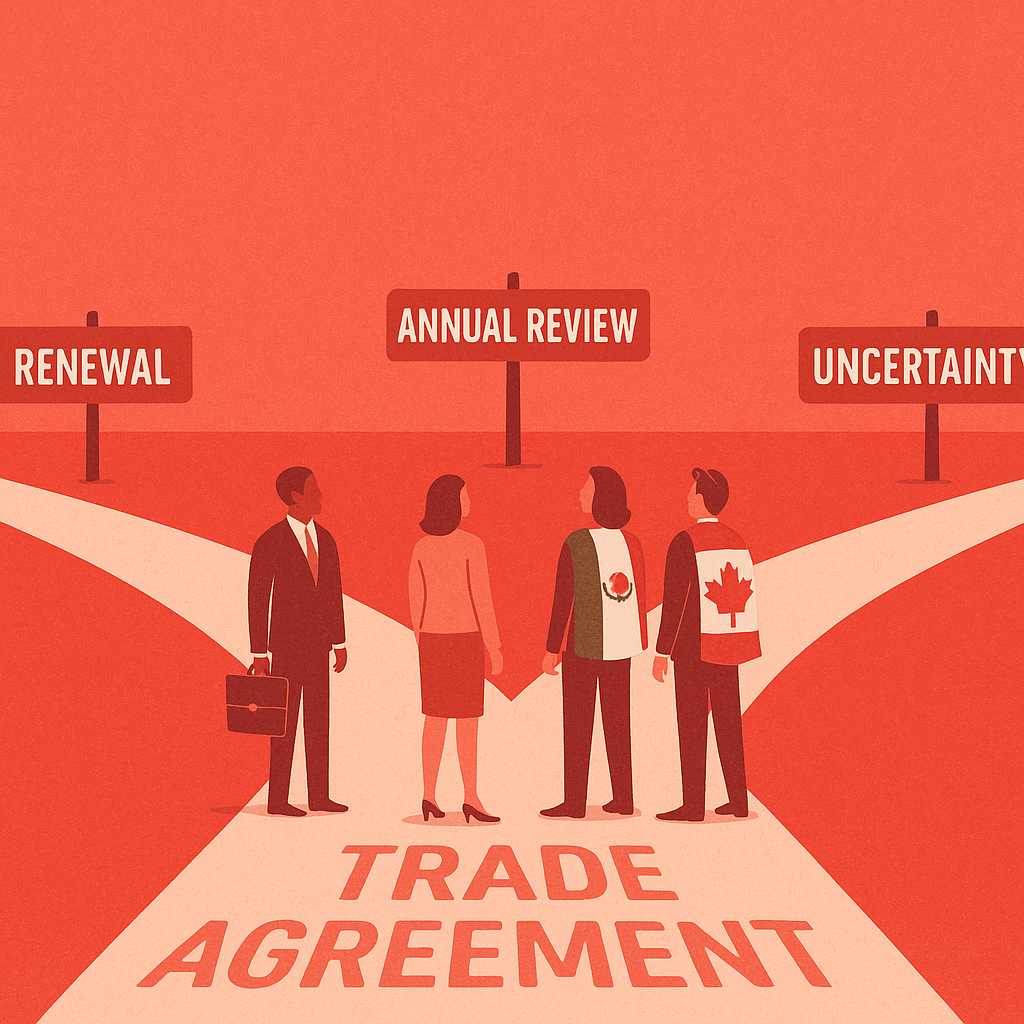
In July 2026, the USMCA trade agreement between the U.S., Mexico, and Canada entered a big moment because the U.S. chose not to renew it as it is. Now, instead of lasting 16 more years, the deal will be checked every year until 2036. If the three countries can't agree during these yearly reviews, the whole agreement will end in 2036. This makes business in North America unsure about the future, so companies might not want to invest long-term. The three countries now have to work together every year to decide if they can keep or improve the trade rules.
On July 1, 2026, the United States, Mexico, and Canada held the mandatory USMCA joint review under Article 34.7. This decision does not terminate the agreement but activates a mandatory ten-year annual review cycle that will determine the future of North American trade relations through 2036.
The Review Mechanism and Current Status
The USMCA remains fully operational with all existing provisions - including tariff exemptions, rules of origin, and dispute settlement mechanisms - continuing unchanged. Under Article 34.7 of the agreement, the three nations were required to conduct a joint review six years after implementation. When the U.S. Trade Representative Jamieson Greer announced that "the United States did not agree to renew the USMCA in its current form," the decision triggered an automatic transition to annual assessments rather than the standard 16-year extension.
If the parties fail to reach consensus during these yearly reviews, the USMCA will automatically terminate on July 1, 2036, potentially returning North America to WTO baseline tariffs.
The annual review process allows the three countries to negotiate improvements at any point during the next decade. If the parties agree in the 2026 review, the USMCA can be extended for another 16 years, to 2042; if renewed again at the next six-year review in 2032, it could extend to 2048. However, without such consensus, the agreement faces certain expiration in 2036.
U.S. Strategic Priorities
The Trump administration's decision to pursue annual reviews rather than automatic renewal reflects several strategic objectives. The U.S. seeks to address persistent trade deficits with both Mexico and Canada while pushing for new concessions on automotive rules of origin and labor enforcement standards.
Beyond traditional trade issues, the review process has become a vehicle for addressing broader continental concerns. The U.S. has explicitly linked the negotiations to non-trade matters including migration control, drug trafficking prevention, and continental defense cooperation. Washington also aims to restrict Chinese companies operating in North America and implement forced labor import prohibitions.
Bilateral Negotiations Framework
The U.S. and Mexico have engaged in discussions on key trade issues, focusing on areas including economic security, industrial rules of origin, automotive rules, agriculture, labor, environment, steel and aluminum trade, and electronic payment services. Meanwhile, the U.S. and Canada have not yet initiated their own bilateral discussions, though trilateral consultations continue.
Potential Outcomes and Economic Impact
The annual review cycle creates sustained uncertainty that could significantly affect business decisions across North America. Companies must now model scenarios for potential rule changes in automotive, agriculture, and energy sectors, which may discourage long-term investment in North American manufacturing until clarity emerges about the agreement's future beyond 2036.
The persistent uncertainty is expected to drive shorter-term supplier contracts and increase compliance costs, as businesses hesitate to commit capital to a region where trade rules could change annually.
Analysts have identified several possible scenarios ranging from full renewal with a 16-year extension to complete collapse where all three nations withdraw and North America returns to WTO baseline tariffs. Between these extremes lie outcomes including renewed agreements with targeted modernizations, continuation under annual reviews through 2036, or partial termination where some sectors revert to pre-USMCA rules while others remain.
What Happens Next
USTR announced public consultations in 2025 ahead of the July 2026 joint review, with comments and a hearing connected to that pre-review process. All existing USMCA dispute panel rulings must be complied with during the review period, and the process cannot reverse previous legal decisions.
The agreement's novel sunset clause provision - designed to force regular reassessment - makes the 2026 review the first mandatory joint evaluation since the pact replaced NAFTA on July 1, 2020. If the parties had reached consensus on renewal in 2026, the next review would not occur until 2032. Instead, they now face annual assessments that will test their commitment to North American economic integration over the coming decade.
Investment risk remains a central concern as the annual review cycle may deter long-term North American investment decisions until 2036 clarity emerges. The institutional framework supporting regional trade could be dismantled if differences remain unresolved, making goods more expensive and less competitive globally while potentially exposing North American economies to increased external vulnerabilities, particularly from competing manufacturing powers like China.